Flash on Location

Taking flash outside means balancing it against daylight, dusk and street lamps rather than a dark studio. These nine tutorials show how much flash power an outdoor portrait needs, how to balance flash with ambient light indoors and out, how to keep the colour of the scene, and how to avoid ghosting and harsh results, with practical shoots in harsh midday sun and after dark.

Understanding Ghosts (and How to Bust Them)

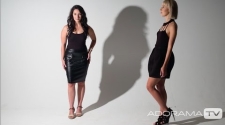
Mark Wallace uses a glass of water to explain aperture and shutter duration, then has Monique and Marley stand still and move during two-to-four-second exposures, showing that moving subjects barely record. Adding a Profoto strobe at one second, f/16 and ISO 200 freezes Monique while Marley appears as a ghost.

How to Balance Indoor and Outdoor Light

Mark Wallace photographs Natasha in a dark room with bright windows, balancing flash against daylight three ways: a speedlight in TTL with high-speed sync and aperture priority, an off-camera flash in a softbox angled to avoid window reflections, and a manual Profoto Acute 2 pack for full-length wide shots.

The Tricks of Using Your Camera's Flash at Night

Andrew Boey answers a viewer asking about on-camera TTL flash at night: use ISO 400-800, f/2 or f/2.8, meter a third-stop under and set flash compensation around minus one stop to avoid oily hotspots. Unable to bounce outdoors, he pulls out the built-in diffuser and insists on lit backgrounds.

Better Than Ambient Light

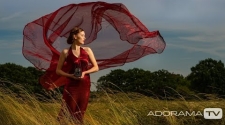
Gavin Hoey shoots a vintage portrait of Jade in a mown field near Gatwick so added light beats the overcast ambient. At f/16, 1/250s and ISO 200 he underexposes the sky, meters a Flashpoint Xplor 600 to f/16, then darkens grass with a Camera Raw adjustment brush at -1.5 stops.

Tricks for Using Flash Without Killing Ambient Colour

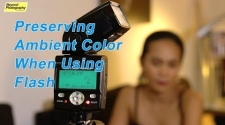
Andrew Boey adds on-camera TTL flash in a tungsten-lit lab without killing the amber ambient: raise ISO to 800-1600, keep auto white balance, not locked Kelvin, slow the shutter until the meter nears zero, bounce into open space, not the ceiling or nearest wall, and cut flash compensation a stop.

How to Use Off-Camera Flash for Beautiful Outdoor Portraits in Bad Light

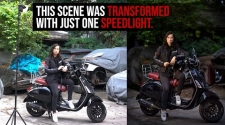
Jiggie Alejandrino, a Philippine portrait and wedding photographer, lights a dusk portrait with one Sony HVL-F60RM triggered by an FA-WRC1M and fitted with MagMod's MagGrid and MagSphere. He shoots a Sony a7R IV with the 85mm f/1.4 GM in aperture priority, flash at quarter power and shade white balance.

Outdoor Flash Photography: How Much Power Do You Need?

Mike Smith tests whether a Godox TT350, V860II, AD200 and AD300 Pro can overpower midday sun, with and without high-speed sync. The bare TT350 copes on camera but fails once diffused; the V860II works at half power in a 90cm softbox; the AD200 manages 1/16 power with its Fresnel head.

Balance Background with Fill Flash

David Bergman answers a viewer whose fill-flash portraits make backgrounds look like paper backdrops, shooting Sarah in Central Park. He stresses matching quality and quantity of light, firing a 600EX-RT in a soft modifier on a Canon EOS R5 at ISO 100, 1/200s and f/2.8, then reducing flash power.

Easy On-Camera Flash Portraits

Gavin Hoey photographs Chloe with a bare Flashpoint speedlight on his Olympus at f/5.6, 1/250s and ISO 200. Direct TTL flash gives edge shadows, so he tilts the head to the ceiling, adds a bounce card for catchlights, bounces off a wall and warns about coloured walls tinting the light.