Flash Photography for Beginners

Flash is the skill that separates photographers who are stuck waiting for good light from those who make it. This course-like sequence starts with a flash on the camera, moves it off, and explains manual power, the aperture-flash relationship, sync speed, optical slave modes and the inverse square law. It ends with a single flash producing six distinct looks from one position.
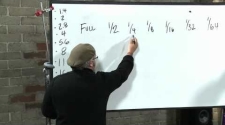
Zack Arias: Aperture and Flash Relationship

Zack Arias explains, in a CreativeLive studio lighting clip, that each halving of flash power, from full down to 1/32, equals one stop, the same as one aperture step. If full power gives correct exposure at f/16, counting down the power scale leads to f/11, f/8, f/5.6, f/4 and f/2.8.

Breaking the 1/250s Sync-Speed Trick

Andrew Boey shows how to shoot optically triggered remote flash beyond the 1/250s sync limit. Because flash duration lengthens at full power, he sets the remote SB-900 and on-camera SB-600 to full manual power, then photographs Vivian at f/2.8, ISO 200 and 1/4000s to 1/8000s for a blurred, darkened background.

Peter Hurley: How to Understand the Inverse Square Law

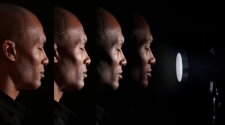
Peter Hurley, in an Fstoppers excerpt from his tutorial Illuminating the Face, explains the inverse square law as fall-off. With a bare Profoto D1 and tape measure in one-foot steps, intensity drops to 25, 11, 6 and 4 per cent; he moves the light back so a subject's ear brightens.

The 888 Formula for Remote Flash

Andrew Boey's 888 formula for off-camera flash: place the light eight feet from the subject, at one or two o'clock and angled down; set it to S1 at 1/8 power; shoot at f/8, ISO 200 and no faster than 1/200s. A softbox costs two stops, so power rises to half.

Off-Camera Flash Manual Tutorial

Spyros Heniadis demonstrates manual off-camera flash by shooting a self-portrait. According to the description, he first gets the flash off the camera with a wireless triggering system, then works through the manual settings that control the result, within a getting-started series that also covers setup and preventing shadows on backdrops.

Flash Photography for Beginners Part 1

Mike Smith opens a beginners' flash series using Yongnuo speedlights in manual mode, not TTL. He explains sync speed with frames below, at and above it, flash duration and matching the zoom head to the lens, suggesting 1/100s, ISO 100, f/5.6 and quarter power, then bouncing off a white ceiling.

Flash Photography for Beginners Part 2

Mike Smith continues his beginners' flash series with self-portrait headshots: flash modes fill, slow sync and rear curtain, why a bare flash gives hard light, bouncing off the ceiling behind the photographer, the built-in diffuser and white card, then taking a Godox flash off camera with a trigger and softbox.

Learn the S1 and S2 Modes of Flashes

Andrew Boey demonstrates optical S1 and S2 modes on a Godox TT685, sold in Sony, Canon and Nikon versions. He backlights a glass bottle against a white wall, flash at half power in S1, on a Canon 60D at ISO 200, 1/100s and f/11, pop-up flash in manual at minimum.

2 Easy Steps to Use a Flash on Your Camera

Andrew Boey photographs backlit Jasmine, showing how average metering darkens her face. Exposure compensation brightens her but overexposes the background, breaking his Famous Five rule that subjects must be brightest, so he underexposes ambient by a stop at f/2.8, ISO 400, adds TTL flash and bounces it off a wall.

Flash Photography for Beginners Part 3: The Inverse Square Law and Why You Need to Understand It

Mike Smith explains the inverse square law for flash: doubling the flash-to-subject distance costs two stops, so f/8 becomes f/4 or ISO 100 becomes 400. He shows three practical uses, controlling background brightness, the fall-off across a face and catchlight size, comparing a flash at 50 centimetres and 2.5 metres.