Lens Basics and Buying

Lenses shape pictures more than camera bodies do, and this set makes the choices clear. It compares zooms with primes, explains which focal lengths suit which subjects, and sets out a sensible order in which to buy. The 50mm gets particular attention: how to get the most from an inexpensive f/1.8, and whether the dearer f/1.4 and f/1.2 versions justify their prices.
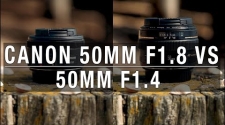
Canon 50mm f/1.8 vs 50mm f/1.4: Is It Worth the Extra Money?

Mark Newton of The School of Photography pits the £100 plastic Canon 50mm f/1.8 STM against the £385 metal-bodied f/1.4, shooting unedited at ISO 100 with hoods on. Tests of colour, contrast, sharpness, bokeh and chromatic aberration reveal slight green fringing on the f/1.4 that the cheaper lens avoids.

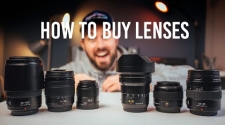
Which Lenses You Should Buy

James Popsys shares how he chooses lenses: apply the good, fast, cheap, pick two rule, judge versatility against actual shooting needs, not reviews, and respect diminishing returns, choosing the pricier Leica 25mm f/1.4 for a focal length he uses constantly but the cheaper 42.5mm f/1.7 over the f/1.2.

The First Two Lenses You Should Buy and How to Use Them (24-70 and 70-200)

Pye Jirsa of SLR Lounge found ninety per cent of 10,000 2018 images came from 24-70mm and 70-200mm lenses, so recommends them first for wedding and portrait photographers. He shows the 24-70 stretching from wide Laguna Beach lines to compressed 70mm portraits, and the 70-200 reaching distant ring exchanges.

What Lens Should I Buy and Why

Paul from Photo Genius decodes lens names like Nikon's 18-55mm f/3.5-5.6 G DX VR, diagrams focal length and field of view, and recommends by genre: Sigma 8-16mm and 12-24mm wide angles for landscapes, and Canon 55-250mm and Nikon 70-300mm telephotos for sport and wildlife, plus a monopod against shake.

Canon 50mm f/1.2 vs f/1.8 for Portrait Photography

Vanessa Joy compares Canon's 50mm f/1.2 and f/1.8 on a 1DX Mark III, shooting a model at ISO 200, f/1.8 and 1/60. Raw files in Lightroom show marginally better clarity from the f/1.2, so the cheaper lens suits a first prime, the f/1.2 earning its price in low-light focusing.

How to Crush It with Your 50mm f/1.8

Paul Heimlund gets more from a Canon 50mm f/1.8 STM: reversing it for macro via reverse ring, lens whacking for dreaminess, shooting products and portraits wide open for a cinematic blur kit lenses cannot match, adding an ND filter for sunny video, and noting its 80mm equivalent on APS-C.

Which Prime Lens Should You Buy? Focal Lengths Compared

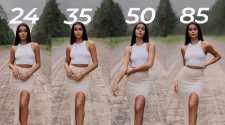
Mitch Lally compares 24mm, 35mm, 50mm and 85mm primes, shooting his friend Kat wide open in identical conditions. The 24mm distorts perspective most, the 35mm offers versatility, the 50mm looks most natural with blurrier backgrounds, and the 85mm compresses and flatters, reducing the background to colour and brightness.

Zoom vs Prime Lenses: Which Should You Get?

Mitch Lally and Carlo O'Brien photograph Amanda at the beach on Canon EOS RPs, Lally swapping between RF 35mm f/1.8 and EF 100mm f/2 while O'Brien uses a Tamron 35-150mm f/2.8-4. They weigh the zoom's range and speed against primes' sharpness, brighter low-light apertures and lens-change hassle.