Night and Low Light

After dark the camera has to work harder, and so does the photographer. These twelve tutorials cover settings and gear for night photography, controlling noise without flash, nightscapes, light trails, fireworks and painting with light. Night portraits get their own lesson, and four videos take street photography into the hours when neon and shop windows become the main light sources.
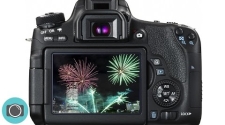
How to Photograph Fireworks: Tips, Tricks, Settings and Gear for Beginners

Paul Farris sets out fireworks essentials: a tripod, a remote release or two-second self-timer, arriving early for test shots, an 18mm or wider lens, and manual focus when autofocus has only black sky. He suggests shutter priority, ISO 400 and four to ten second exposures, or manual mode.

Night Photography: Nightscapes and Trailing Lights

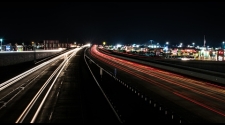
RealWorld uses an entry-level Nikon D3400 on a tripod for two kinds of night photography. From a bridge over a road he captures headlight and tail-light trails with an eight-second exposure at f/32, then photographs the uplit Palladium in Carmel after midnight at ISO 100, f/10 and 1.6 seconds.

Low Light Photography Made Easy: Reduce Noise Without Flash

Jason Vong explains how to shoot cleaner low light photographs without flash. Drawing on recommended accessories, including a Joby GorillaPod, a Manfrotto mini tripod and fast primes for Sony, Canon, Nikon and Fujifilm, he covers ways to cut digital noise, such as steadying the camera and gathering more light.

Night Photography for Beginners: Tips and Camera Settings Explained

Paul Farris starts at Brisbane's Kangaroo Point at sunset but retreats to the studio after poor light defeats the video. He recommends manual control and a tripod like the Manfrotto Pixi Evo or Joby Gorillapod, and demonstrates dialling shutter speed from 1/4000 down to tenths, seconds and beyond.

Photo Challenge 2: The Painting with Light Challenge

Paul Farris sets painting with light as week two of his lockdown photography challenge. A multi-second exposure lets a moving light source, even a phone torch, draw trails; he demonstrates with the self-timer, sweeping light behind a subject, darkening via exposure compensation, then wrapping it around the subject.

Shooting Street Photography at Night

Brian Lloyd Duckett explains night street photography in London's Soho and Chinatown: hunt for light that gives depth and chiaroscuro contrast, study its hardness, direction and colour, build compositions around it, leave white balance on auto, use manual focus with red peaking, and carry primes covering 35 to 85mm equivalent.

Night Portrait Photography

David Bergman answers a reader planning night-time wedding portraits with little ambient light and no assistant. He works through foreground and background exposure, contrasts flat direct flash with dragging the shutter, moves the flash off-camera, balances background lights, adds a second light and introduces flare behind the couple.

5 Tips for Street Photography at Night: Get the Cinematic Look

Eren Sarigul offers five tips for cinematic night street photography: treat passers-by as film characters, seeking hats, umbrellas and trench coats; find a backdrop and work it from different angles before waiting for a subject; use a 35mm f/1.4 prime; hold 1/60 without clipping highlights; and chase colourful artificial light.

Amazing Nightscape Photography with Basic Camera Gear

Trevor Jones photographs the Milky Way over a river from a dark 85-acre property, using an unmodified Canon DSLR, 18-55mm kit lens and basic tripod, no tracker or filters. He covers new-moon timing, escaping light pollution, manual mode and focus, and shooting eight to ten frames to stack.

Sunset Through to Night Photography: Low Light Tips for Beginners

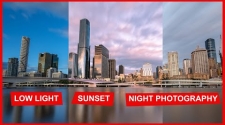
Paul Farris reshoots his 2010 Brisbane skyline panorama while sharing low light advice: manual modes, a tripod and ideally a remote. He covers aperture priority at f/11 and ISO 200, f/11 to f/16 for starbursts, a 30-second exposure blurring river and clouds, and horizons on the lower third.