Videos

Sunset Photography 101: 7 Secrets to Stunning Sunsets

Seven sunset tips from ExpertPhotography: arrive 90 minutes early and stay at least 40 minutes after sunset; seek scattered, wispy cloud; use PhotoPills to predict where the sun sets; shoot aperture priority 1⅓ stops under to hold cloud highlights; focus manually a third into the scene; and trust the histogram.

Sunset Photography Tips

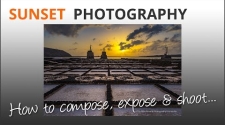
Mike Browne shoots sunset at a Lanzarote spot with derelict windmills and foreground pools, urging photographers to arrive early for golden hour, prefer a scene containing the sunset to sky alone, watch the changing light and align symmetrical patterns precisely. He uses f/16, 1/250 and ISO 200, checking the histogram.

Photography at Home: Dramatic Clouds From Your Window, Edited in Lightroom

Yuri from YuriFineart photographs dramatic clouds from a balcony or window using a lens of 100mm or longer to isolate the patch of sky. Shooting raw, he builds a black and white edit in Lightroom: maximum contrast, lowered blacks, raised shadows and whites, clarity, tone-curve tweaks, noise reduction and vignetting.

How to Get Dramatic Clouds in Overcast Conditions

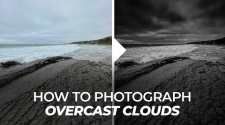
Pye Jirsa shoots an overcast scene on a Canon EOS R5 at 28mm, f/5.6, 1/1000 and ISO 100, then on an iPhone 12 Pro, watching the histogram to avoid clipping highlights. In Lightroom Mobile a graduated filter over the sky lowers exposure before a monochrome conversion and dehaze and clarity.

How to Photograph and Process Forests

Alister Benn explores rain-soaked woods near his Scottish west-coast home, where wet weather saturates the greens, arguing forest photography means isolating differences with 35 to 70mm lenses. In the office he adds depth by painting mist into the background, restrained by a luminance range mask, and weighs flipping the frame.

How I Focus Stack for Perfectly Sharp Landscape Photos

Mark Denney demonstrates focus stacking for landscape photographs with a wide-angle lens, where focusing on a foreground element leaves the background soft and vice versa. He shows how taking several frames focused at different distances, then blending them, delivers sharpness from the nearest foreground through the mid-ground to the background.

Why You Don't Want to Shoot at f/22, Gin and Vodka in the Landscape, and New Filter Releases

Photography Online's August 2021 show follows Marcus McAdam shooting Isle of Skye Distillers' gin and vodka in Skye landscapes with a Canon 5DS R and 50mm f/1.4, explains why stopping down to f/22 is a poor choice, and reviews Kase clip-in sensor filters and the H&Y REVORING variable ND polariser.

How to Choose the Best Focal Length in Landscape Photography: 14-200mm

Nigel Danson works through his lens choices from 14mm to 200mm, prompted by a new Nikon Z 70-200mm. He explains how human vision matches 40 to 55mm, how depth of field varies, when ultra-wides, 18-24mm, 30-60mm and telephotos suit a scene, and reveals his most-used focal length from Lightroom statistics.

Landscape Photography Practice: How to Compose by Feel

Alister Benn revisits two places he has photographed for years, Kirkjufell in Iceland and a beach on Spain's north coast, tracing how his compositions evolved from the well-known 14mm aurora view, cropped to 4x5, to an icicle-framed cave shot in sleet, and arguing that composition is the arrangement of feeling.

How to Make Better Landscape Photographs Today

Alister Benn asks what better means, admitting a dramatic 2015 Tibet image was fabricated for social media approval rather than drawn from what he witnessed. His remedy is to stop chasing popular templates and start practising the fundamentals of seeing, composing and exposing, guided by his five triggers of engagement.