Videos

The Tricks of Using Your Camera's Flash at Night

Andrew Boey answers a viewer asking about on-camera TTL flash at night: use ISO 400-800, f/2 or f/2.8, meter a third-stop under and set flash compensation around minus one stop to avoid oily hotspots. Unable to bounce outdoors, he pulls out the built-in diffuser and insists on lit backgrounds.

Understanding Ghosts (and How to Bust Them)

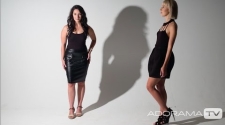
Mark Wallace uses a glass of water to explain aperture and shutter duration, then has Monique and Marley stand still and move during two-to-four-second exposures, showing that moving subjects barely record. Adding a Profoto strobe at one second, f/16 and ISO 200 freezes Monique while Marley appears as a ghost.

Better Than Ambient Light

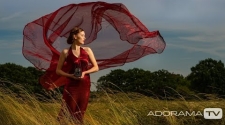
Gavin Hoey shoots a vintage portrait of Jade in a mown field near Gatwick so added light beats the overcast ambient. At f/16, 1/250s and ISO 200 he underexposes the sky, meters a Flashpoint Xplor 600 to f/16, then darkens grass with a Camera Raw adjustment brush at -1.5 stops.

Easy On-Camera Flash Portraits

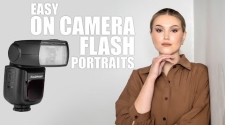
Gavin Hoey photographs Chloe with a bare Flashpoint speedlight on his Olympus at f/5.6, 1/250s and ISO 200. Direct TTL flash gives edge shadows, so he tilts the head to the ceiling, adds a bounce card for catchlights, bounces off a wall and warns about coloured walls tinting the light.

Tricks for Using Flash Without Killing Ambient Colour

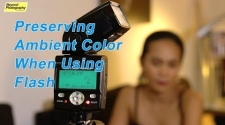
Andrew Boey adds on-camera TTL flash in a tungsten-lit lab without killing the amber ambient: raise ISO to 800-1600, keep auto white balance, not locked Kelvin, slow the shutter until the meter nears zero, bounce into open space, not the ceiling or nearest wall, and cut flash compensation a stop.

Balance Background with Fill Flash

David Bergman answers a viewer whose fill-flash portraits make backgrounds look like paper backdrops, shooting Sarah in Central Park. He stresses matching quality and quantity of light, firing a 600EX-RT in a soft modifier on a Canon EOS R5 at ISO 100, 1/200s and f/2.8, then reducing flash power.

How to Balance Indoor and Outdoor Light

Mark Wallace photographs Natasha in a dark room with bright windows, balancing flash against daylight three ways: a speedlight in TTL with high-speed sync and aperture priority, an off-camera flash in a softbox angled to avoid window reflections, and a manual Profoto Acute 2 pack for full-length wide shots.

Outdoor Flash Photography: How Much Power Do You Need?

Mike Smith tests whether a Godox TT350, V860II, AD200 and AD300 Pro can overpower midday sun, with and without high-speed sync. The bare TT350 copes on camera but fails once diffused; the V860II works at half power in a 90cm softbox; the AD200 manages 1/16 power with its Fresnel head.

How to Use Off-Camera Flash for Beautiful Outdoor Portraits in Bad Light

Jiggie Alejandrino, a Philippine portrait and wedding photographer, lights a dusk portrait with one Sony HVL-F60RM triggered by an FA-WRC1M and fitted with MagMod's MagGrid and MagSphere. He shoots a Sony a7R IV with the 85mm f/1.4 GM in aperture priority, flash at quarter power and shade white balance.

Use 1 Flash and Get 6 Unique Photo Styles

Andrew Boey, with model Nina, builds six looks from one flash: on-camera TTL bounced off ceiling corners, off-camera on a stand triggered by the pop-up flash, then a home-made beauty dish for a low-key shot, and breaking sync at f/1.8 and 1/4000s with both flashes at full power.