Videos

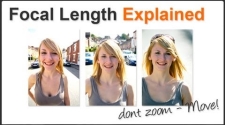
Focal Length Explained Part 1: Don't Just Zoom, Move

Mike Browne treats a zoom as a set of primes, photographing Natasha in a street at 10, 20, 35, 70, 150, 250 and 500mm, stepping back so she fills the same frame, showing how focal length changes the environment behind her and how wide lenses pull her face forward.

Stop These Aperture Mistakes (f/11 to f/16)

Mark Denney reviews five aperture mistakes from his early landscape photography, starting with shooting everything at f/11 because professionals did, which left close foregrounds out of focus. He urges deciding the vision before choosing settings, and describes testing a lens across its aperture range to find its sweet spot.

Taking Portraits in Aperture Priority

Jana Williams demonstrates how aperture priority mode on a DSLR helps produce soft, flattering portraits. The short tutorial explains why a portrait photographer might hand shutter speed to the camera and concentrate on aperture alone, with the chosen opening shaping how softly the background falls away behind the subject.

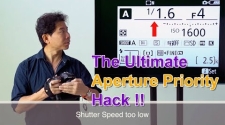
The Ultimate Aperture Priority Hack

Andrew Boey explains why aperture priority produces blur when its shutter slows in dim light. His Nikon fix: enable auto ISO sensitivity capped at ISO 6400 with a minimum shutter speed, then switch auto ISO off, set ISO 100 and re-enable it so the camera raises ISO instead.

How to Control What's in Focus

Mark Wallace photographs Nesli Avci before an aqueduct in Istanbul to demonstrate what controls depth of field. He shoots at f/1.4 then f/16 to blur and sharpen the background, compares 50mm and 21mm Leica lenses at the same aperture, and moves closer and further with a 35mm at f/2.

How to Blur Backgrounds: Depth of Field for Beginners

Paul from Photo Genius photographs puppy Boo with Canon and Nikon DSLRs in aperture priority, showing beginners how to blur a background: open the aperture to its widest, f/3.5 on an 18-55mm kit lens, and zoom in or fit a telephoto, noting kit zooms close to f/5.6 when extended.

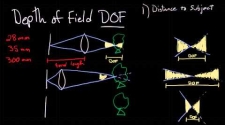
A Simple Guide to Depth of Field

Dylan Bennett uses diagrams to explain depth of field: the field is the zone meant to be in focus, its depth how far that zone extends. He traces light rays through lens to sensor, showing why sharpness falls off, then demonstrates how subject distance and focal length control it.

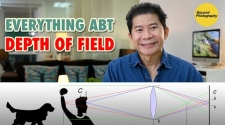
Depth of Field Explained

Andrew Boey defines depth of field as the zone of sharpness along a scene's depth axis, then shows its uses: separating subject from location, including or excluding people, and keeping everything sharp above f/8 for groups and events. He demonstrates the DSLR preview button and previews the factors governing it.

Top 10 Things About Aperture

Andrew Boey answers ten aperture questions: f/2 to f/4 for portraits, f/11 or f/16 for daytime landscapes, f/5.6 to f/8 at night and f/8 to f/22 for macro and still life. He explains his ISO-first setup order, why cheap zooms lose aperture when zoomed, and the full-stop f-number series.

New to Photography: Start Here with Aperture Priority

Paul from Photo Genius introduces aperture priority as a step out of auto: set the aperture and the camera handles shutter speed and ISO. He shows an 18-55mm kit lens losing its widest aperture when zoomed, contrasts constant-aperture primes, and explains how aperture affects light and depth of field.